Our Mission Explained
Our mission is to study properties of fluids and solids, their complex motions and interactions and processes occurring in them under thermal and/or mechanical loading. As a multidisciplinary research organization, we also study complex dynamics of mechanical systems, electromechanical energy conversions and their control using power electronic devices, and develop applications of thermal plasma. To fulfill our mission, we create mathematical models and algorithms, diagnostic and measurement methods and scientific sensors and instruments. Besides curiosity-driven research, which is at the heart of our purpose, we transfer our knowledge to society by educating future scientists, promoting public awareness of science and applying our research findings in industrial settings and the public sector to initiate innovations in various fields of technology. To achieve the best results, we foster enthusiasm, motivation and confidence of our staff by implementing the principles of the European Charter for Researchers and constantly enriching our Human Resource Strategy for Researchers.
The Mission Statement in Practice
The Mission Statement serves as a value-driven complement to the Institute’s official Foundation Charter. While the Foundation Charter is a formal, administrative document that defines our legal status, organizational structure, statutory activities, authorized research disciplines, and regulatory limitations, the Mission Statement articulates the Institute’s core identity and primary purpose—its scientific DNA.
By defining why we conduct research, what methodologies we employ, whom we serve, and how we support our staff, the mission establishes four fundamental pillars:
- Pillar I – Scientific Scope: Pursuing multidisciplinary research focused on engineering physics, mechanics, and applied physical sciences.
- Pillar II – Research Type: Prioritizing basic, curiosity-driven research as our core purpose—a defining feature of our identity within the Czech Academy of Sciences, distinguishing us from mission-oriented or purely applied research institutions or research infrastructures.
- Pillar III – Societal Impact: Translating scientific progress to society through higher education, public outreach, and direct application in industrial settings and the public sector.
- Pillar IV – Human Resources & Work Culture: Cultivating a supportive working environment by implementing the European Charter for Researchers and the HR Strategy for Researchers (HRS4R).
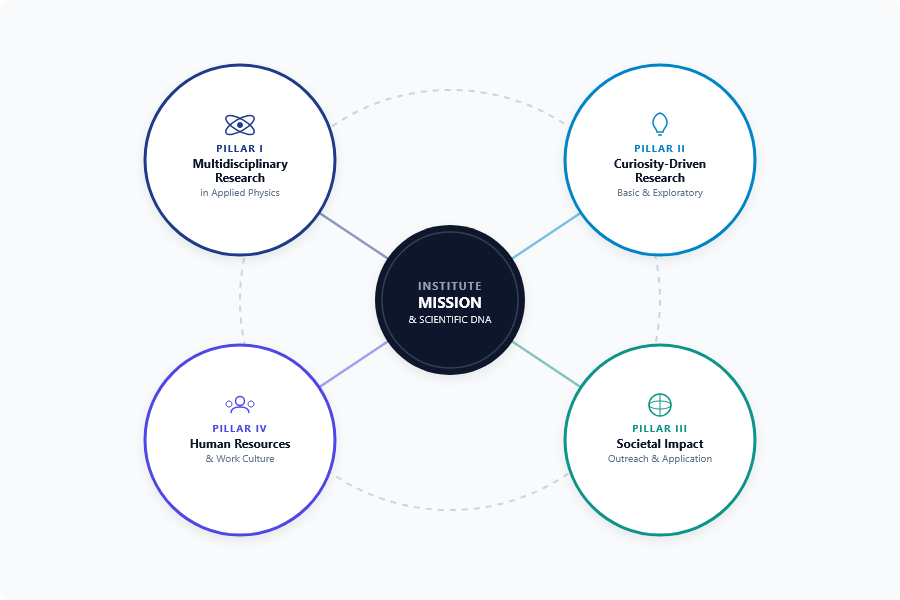
Rather than remaining abstract principles, these four pillars directly shape our institutional policies, internal mechanisms, and everyday operational processes, as outlined by the following practical examples.
Pillar I: Scientific Scope
In accordance with the European Charter for Researchers, our scientists enjoy freedom of scientific research—including the freedom to define research questions, choose methodologies, and explore innovative ideas. However, as the Charter explicitly recognizes, this freedom is not absolute and operates within defined management, legal, and operational boundaries. At our Institute, a key operational boundary is our statutory scientific scope: curiosity-driven exploration must be exercised within our authorized disciplines, and researchers should align their research with our primary mission.
The following internal safeguards ensure that our research topics respect both scientific freedom and our scientific scope:
Scope Verification of External Grant Proposals
The practical application of Pillar I is directly demonstrated in the mandatory approval workflow for all external grant applications. To ensure that project topics fit within the Institute’s statutory scientific scope, a two-stage verification is required:
- Preliminary Intent Clearance: Before drafting a full proposal, the researcher must submit a project intent outlining the preliminary topic, core objectives, and collaborating partners. The direct supervisor, the Deputy Director for Science and Research, and the Deputy Director for Finance and Operations review the intent to confirm that the proposed topic falls squarely within the Institute’s defined research fields.
- Final Scope Endorsement by the Institute Board: Once fully prepared, the complete proposal text is submitted to the Institute Board. The Board performs the final review to ensure that the proposal strictly aligns with the Institute’s mission and scientific orientation before it is officially submitted to the funding agency.
Strategic Scope of Internal Projects
The Institute’s Committee for Internal Projects (appointed annually by the Director) evaluates proposals for internal pilot projects and infrastructure development in accordance with the internal regulations on internal projects. The regulation explicitly requires that all proposal topics align with the portfolio of scientific fields defined by the Founding Charter and the Institutional Strategic Plan (Dlouhodobá koncepce rozvoje výzkumné organizace, DKRVO), which the Institute prepares and submits to the Czech Academy of Sciences every five years.
Pillar II: Research Type
The following internal mechanisms actively strengthen and protect the Institute’s primary focus on basic, curiosity-driven research:
Institutional Framework for Internal Projects
Under the internal regulations, internal project calls are divided into two distinct categories: infrastructure development projects and internal research projects—officially designated within the Institute as “pilot projects”. While infrastructure projects build technological capacity, pilot projects are strictly dedicated to basic scientific research and exploratory inquiry.
Post-GAČR Internal Funding
Since January 2026, researchers have been able to apply for a dedicated scheme within internal research funding termed “Post-GAČR projects.” Unfunded basic research proposals submitted to the Czech Science Foundation (GAČR)—across standard, international, or Lead Agency calls—that scored within the top 25% are eligible for internal support. To minimize administrative burden, applicants do not submit a new project proposal; they simply provide the official GAČR evaluation protocol. Approximately 50% of the overall internal project budget is allocated specifically to these Post-GAČR projects, awarded strictly by GAČR ranking until allocated funds are exhausted. This scheme provides crucial bridge funding to high-quality basic research proposals that fell just short of national funding solely due to agency budget constraints.
Targeted Focus of Pilot Projects
Beyond Post-GAČR funding, internal regulations explicitly mandate that pilot projects are primarily intended to support: i) advanced exploratory research, and ii) independent research by PhD students and Early-Career Researchers, enabling them to build their own research profiles independently of larger team grants.
Application of CoARA Principles in Researcher Evaluations
During mandatory researcher evaluations (“atestace”), the Evaluation Committee applies principles aligned with the Czech Academy of Sciences CoARA Action Plan 2024–2027. Assessment prioritizes qualitative evaluation and intrinsic scientific depth over raw output volume. Researchers highlight up to three core scientific achievements—each of which can be supported by several outputs—for direct peer review by the Committee. By directly evaluating the scientific substance of these selected works alongside properly interpreted quantitative metrics (rather than judging quality based on journal prestige alone), the Institute actively protects and rewards curiosity-driven research that aims for deep scientific breakthroughs rather than high-volume incremental publishing.
Pillar III: Societal Impact
Institutional Public Outreach & Science Popularization
The practical application of Pillar III is visibly demonstrated through regular large-scale public engagement initiatives organized and supported by the Institute:
- Open Days: Every autumn, as part of the Czech Academy of Sciences Week (Týden Akademie věd ČR), the Institute opens its facilities to students, families, and science enthusiasts through guided laboratory tours, live experimental demonstrations, and expert public lectures.
- Science Fair (Veletrh vědy): The Institute participates annually in this nationwide event, presenting its research results and technological applications to the broader public in an engaging and accessible format. Participation rotates flexibly among research groups—with one to three teams representing the Institute each year—ensuring that our full thematic spectrum is showcased over time.
Recognizing Researchers’ Societal Contribution
To ensure that knowledge transfer, education, public engagement, and institutional service are actively recognized rather than treated as secondary tasks, the Institute’s formal research evaluation framework embeds societal impact into researcher performance assessment. Specifically, the internal methodology for mandatory researcher evaluations (“atestace”), updated in May 2026, includes reference competency guidance outlining typical activities across all researcher qualification grades, serving as a reference tool for researchers. It structures researcher competencies into core scientific domains (including publication activity and research outputs, preparation of and participation in research projects, and position and activity within the scientific community) and complementary activity areas:
- Teaching (encompassing lecturing and student supervision)
- Societal Contribution (encompassing public outreach, knowledge transfer, commercialization, and policy contributions)
- Service to the Institute and the Czech Academy of Sciences (encompassing service on boards, committees, or advisory bodies)
By explicitly incorporating these broader competencies alongside traditional research outputs, the mandatory evaluation framework formally recognizes and values each researcher’s contribution to Pillar III of the Institute’s mission.
Pillar IV: Human Resources & Workplace Culture
The practical application of this pillar is reflected in the Institute’s continuous commitment to maintaining the HR Excellence in Research Award. Rather than a static commitment, the Institute actively implements its updated HRS4R Action Plan 2026–2029 as a key instrument for driving continuous institutional culture change and fostering an open, supportive working environment in line with the European Charter for Researchers.
Back to Human Resource Strategy for Researchers Home